The Infrastructure Gap: Navigating Urban Growth and Environmental Risks in Bhopal
Bhopal, while known as the "City of Lakes" and frequently ranked as one of India's cleanest state capitals, faces a unique set of urban and environmental challenges as it expands in 2026.
As someone closely monitoring the Bhopal Development Authority (BDA) and land policies like those in Vidhya Nagar Phase 2, you will likely recognize these structural and systemic issues:
1. Environmental & Water Management
Pollution of the Upper Lake (Bada Talab): Despite its heritage status, the lake faces constant threats from untreated sewage inflow and encroachment. This is critical because the lake provides nearly 40% of the city’s drinking water.
Deteriorating Lower Lake: Unlike the Upper Lake, the Lower Lake suffers from high levels of eutrophication (nutrient buildup) and plastic waste, affecting the local micro-climate.
Groundwater Depletion: In areas like Kolar and the newly developing outskirts, the water table has dropped significantly, making residents dependent on private tankers or irregular municipal supply.
2. Urban Planning & Infrastructure
Unorganized Fringe Expansion: Areas on the outskirts (near Hoshangabad Road and the bypass) are growing faster than the infrastructure. This leads to "rurban" pockets where high-rise apartments exist without proper drainage or street lighting.
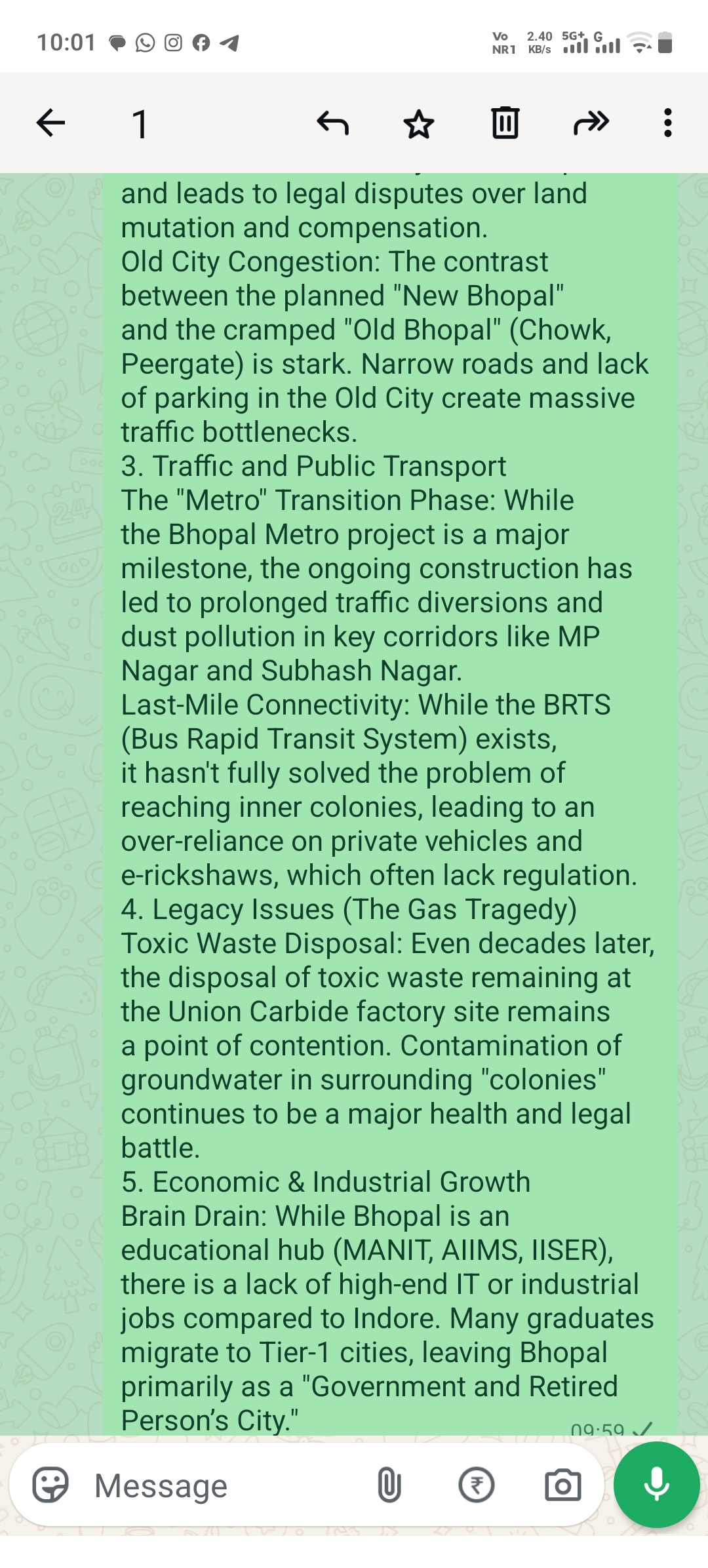
The Land Pooling Delay: Policies like the Land Pooling Policy (which you are tracking) often face bureaucratic delays. This creates uncertainty for developers and leads to legal disputes over land mutation and compensation.
Old City Congestion: The contrast between the planned "New Bhopal" and the cramped "Old Bhopal" (Chowk, Peergate) is stark. Narrow roads and lack of parking in the Old City create massive traffic bottlenecks.
3. Traffic and Public Transport
The "Metro" Transition Phase: While the Bhopal Metro project is a major milestone, the ongoing construction has led to prolonged traffic diversions and dust pollution in key corridors like MP Nagar and Subhash Nagar.
Last-Mile Connectivity: While the BRTS (Bus Rapid Transit System) exists, it hasn't fully solved the problem of reaching inner colonies, leading to an over-reliance on private vehicles and e-rickshaws, which often lack regulation.
4. Legacy Issues (The Gas Tragedy)
Toxic Waste Disposal: Even decades later, the disposal of toxic waste remaining at the Union Carbide factory site remains a point of contention. Contamination of groundwater in surrounding "colonies" continues to be a major health and legal battle.
5. Economic & Industrial Growth
Brain Drain: While Bhopal is an educational hub (MANIT, AIIMS, IISER), there is a lack of high-end IT or industrial jobs compared to Indore. Many graduates migrate to Tier-1 cities, leaving Bhopal primarily as a "Government and Retired Person’s City."