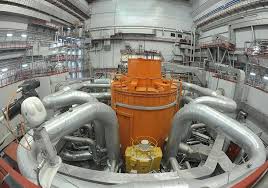
High Energy Electron Collision Phenomenon and Electromagnetic Spectrum Simulation-R&D
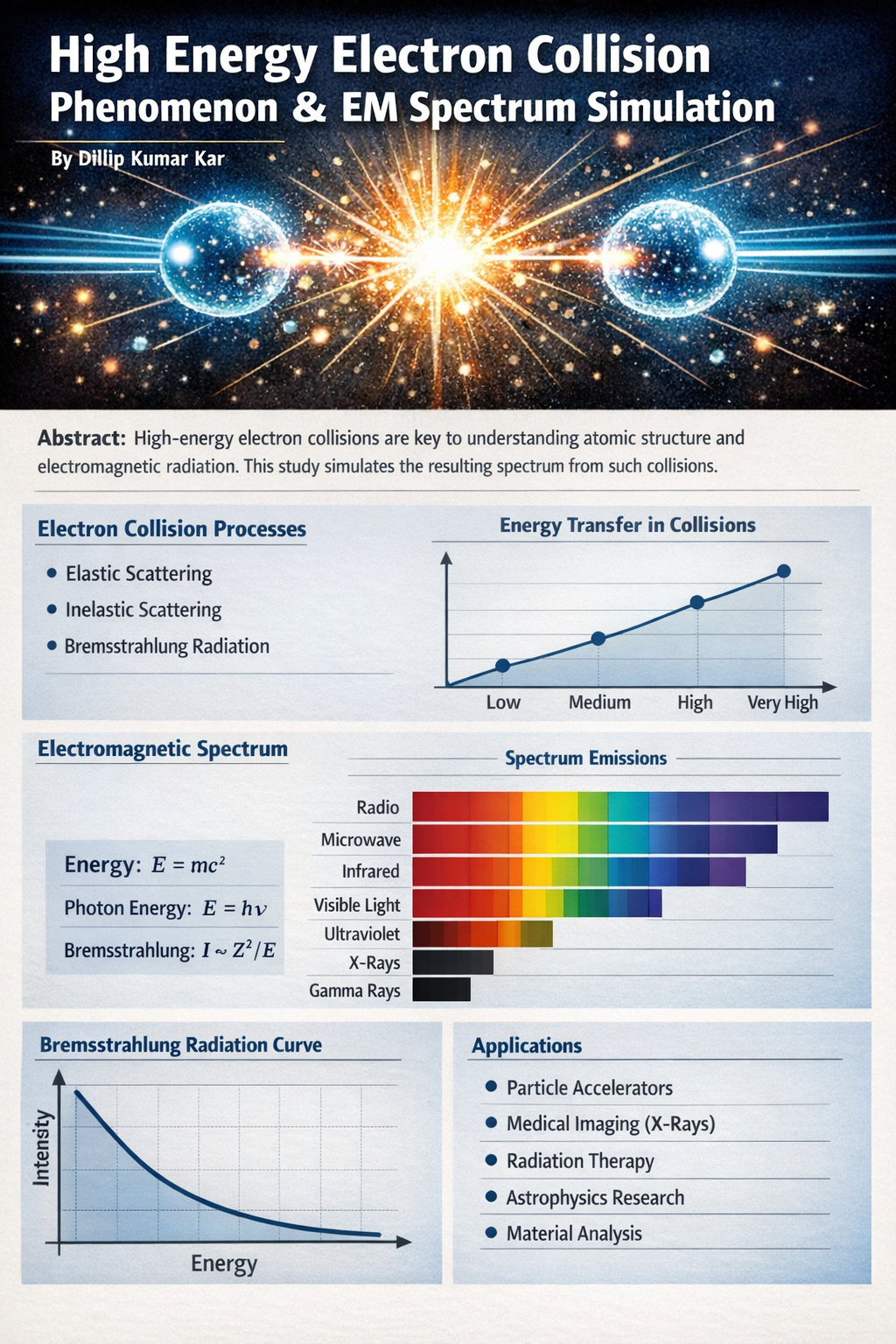
High Energy Electron Collision Phenomenon
and Electromagnetic Spectrum Simulation
Author: Dilip Kumar Kar
Abstract
High-energy electron collisions play a fundamental role in modern physics, contributing to the understanding of atomic structure, particle interactions, and electromagnetic radiation. This study explores electron behavior under high-energy conditions and presents a simulation framework for analyzing the resulting electromagnetic spectrum. The integration of theoretical models with computational methods enables visualization of radiation patterns and energy transfer mechanisms.
Introduction
Electron collision phenomena are central to nuclear physics, accelerator science, and materials engineering. When electrons are accelerated to high velocities and collide with atoms or particles, they undergo complex interactions governed by quantum mechanics and electrodynamics. These interactions produce radiation across the electromagnetic spectrum.
Theory of High-Energy Electron Collisions
Elastic Scattering: Direction changes without energy loss
Inelastic Scattering: Energy transfer to atoms
Bremsstrahlung Radiation: Emission due to deceleration
Secondary Emission: Release of additional electrons
Governing principles include Maxwell’s Equations, Quantum Electrodynamics (QED), and Conservation Laws of Energy and Momentum.
Electromagnetic Spectrum Generation
Radio Waves – Low energy transitions
Microwaves – Molecular interactions
Infrared – Thermal radiation
Visible Light – Electron transitions
Ultraviolet – High-energy excitation
X-rays – Inner shell electron transitions
Gamma Rays – Nuclear interactions
Simulation Methodology
1. Electron Beam Modeling
Energy range: keV to GeV
Velocity and trajectory calculation
2. Collision Environment
Target material properties
Interaction cross-sections
3. Radiation Modeling
Bremsstrahlung spectrum
Photon emission models
4. Visualization
Frequency vs Intensity plots
Time-based emission graphs
Mathematical Representation
Energy Relation: E = mc²
Photon Energy: E = hν
Bremsstrahlung Intensity: I ∝ Z² / E
Applications
Particle Accelerators
Medical Imaging (X-rays)
Radiation Therapy
Astrophysics Research
Material Analysis
Conclusion
High-energy electron collisions provide a powerful mechanism for generating electromagnetic radiation across a wide spectrum. Simulation-based approaches enhance understanding, improve experimental accuracy, and support technological advancements in multiple scientific domains.
Keywords
High-energy electrons, collision physics, electromagnetic spectrum, Bremsstrahlung, simulation, quantum electrodynamics